


World Ozone Day -2024

ప్రపంచ ఓజోన్ దినోత్సవం సందర్భంగా- గవర్నమెంట్ గిరిరాజ్ డిగ్రీ కళాశాల భౌతికశాస్త్ర విభాగాధిపతి Dr.P. రామకృష్ణ గారి ప్రసంగవ్యాసం
ఈ కార్యక్రమం రేపు ఉదయం 8 గంటల 30 నిమిషాలకు ప్రసారమవుతుంది. వినండి ఆకాశవాణి, నిజామాబాద్(FM-103.2 Mhtz) కేంద్ర కార్యక్రమాలు ఇంకా "News on air -mobile app లో కూడా ప్రసారమవుతుంది.

YouTube link of Radio lecture
https://youtu.be/_4e4HtHn6wM?si=SFA-LWIhn1LCmcOi




Successful launch of PSLV-C56
The launch of PSLV-C56 carrying DS-SAR satellite, along with 6 co-passengers from the first launch-pad of SDSC-SHAR, Sriharikota is accomplished successfully on July 30, 2023 at 06:30 hrs IST.
PSLV-C56 is configured in its core-alone mode, similar to that of C55. It would launched DS-SAR, a 360 kg satellite into a Near-equatorial Orbit (NEO) at 5 degrees inclination and 535 km altitude.
DS-SAR
The DS-SAR satellite is developed under a partnership between DSTA (representing the Government of Singapore) and ST Engineering. Once deployed and operational, it will be used to support the satellite imagery requirements of various agencies within the Government of Singapore. ST Engineering will use it for multi-modal and higher responsiveness imagery and geospatial services for their commercial customers.
DS-SAR carries a Synthetic Aperture Radar (SAR) payload developed by Israel Aerospace Industries (IAI). This allows the DS-SAR to provide for all-weather day and night coverage, and capable of imaging at 1m-resolution at full polarimetry.
The co-passengers are:
- VELOX-AM, a 23 kg technology demonstration microsatellite.
- ARCADE Atmospheric Coupling and Dynamics Explorer (ARCADE), an experimental satellite
- SCOOB-II , a 3U nanosatellite flying a technology demonstrator payload
- NuLIoN by NuSpace, an advanced 3U nanosatellite enabling seamless IoT connectivity in both urban & remote locations.
- Galassia-2, a 3U nanosatellite that will be orbiting at low earth orbit.
- ORB-12 STRIDER , satellite is developed under an International collaboration
 For more details-----> https://www.isro.gov.in/PSLVC56_DS_SAR_Mission.html

Final orbit-raising manoeuvre of Chandrayaan-3

The Indian Space Research Organisation (ISRO) on Tuesday (July 25) successfully completed the fifth and final orbit-raising manoeuvre (Earth-bound perigee firing) of the Chandrayaan-3 mission. It was performed successfully from ISRO Telemetry, Tracking and Command Network (ISTRAC) in Bengaluru.
The spacecraft is expected to attain an orbit of 1,27,609 km x 236 km. This means that Chandrayaan-3 is now in an orbit, which, when closest to Earth is at 236 km and when farthest is at 1,27,609 km.
“The achieved orbit will be confirmed after the observations,” ISRO said after the successful orbit-raising manoeuvre.
The four earlier orbit raising manoeuvres were performed by ISTRAC between July 15 and July 20.
Following the final orbit-raising manoeuvre, ISRO will perform the TransLunar Injection (TLI) on August 1 to slingshot Chandrayaan-3 towards the Moon.
“The next firing, the TransLunar Injection (TLI), is planned for August 1, 2023, between midnight and 1 a.m. IST,” ISRO said.
The Chandrayaan-3 consists of a lander module (LM), propulsion module (PM) and a rover which was launched by the LVM3-M4 on July 14.
After the TLI takes place, the PM and the LM separation will happen on August 17. A series of deboost manoeuvres is also scheduled to take place before the power descent phase for the soft landing on the Moon. The lander is expected to touch down on the Moon surface on August 23 at 5.47 p.m.
*ఉత్తరాయనాంతం*
21st JUNE
*SUMMER SOLSTICE*
*ఉత్తరాయనాంతం*
Sun will be on Tropic of Cancer.
Today we will have longest day.

QUANTUM COMPUTING
Why do we need quantum computers?
For some problems, supercomputers aren’t that super.
When scientists and engineers encounter difficult problems, they turn to supercomputers. These are very large classical computers, often with thousands of classical CPU and GPU cores. However, even supercomputers struggle to solve certain kinds of problems.
If a supercomputer gets stumped, that's probably because the big classical machine was asked to solve a problem with a high degree of complexity. When classical computers fail, it's often due to complexity
Complex problems are problems with lots of variables interacting in complicated ways. Modeling the behavior of individual atoms in a molecule is a complex problem, because of all the different electrons interacting with one another. Sorting out the ideal routes for a few hundred tankers in a global shipping network is complex too.
When scientists and engineers encounter difficult problems, they turn to supercomputers. These are very large classical computers, often with thousands of classical CPU and GPU cores. However, even supercomputers struggle to solve certain kinds of problems.
If a supercomputer gets stumped, that's probably because the big classical machine was asked to solve a problem with a high degree of complexity. When classical computers fail, it's often due to complexity
Complex problems are problems with lots of variables interacting in complicated ways. Modeling the behavior of individual atoms in a molecule is a complex problem, because of all the different electrons interacting with one another. Sorting out the ideal routes for a few hundred tankers in a global shipping network is complex too.
How do they work?
A classical processor uses bits to perform its operations. A quantum computer uses qubits (CUE-bits) to run multidimensional quantum algorithms.
A qubit (quantum bit) is the fundamental unit of information in quantum computing. The qubit (CUE-bit) was first used by Benjamin Schumacher and it represents the core building block for the future quantum computers.
In classical computing the unit of information is the bit which can have one of the two values: 0, 1. A qubit, on the other hand, can have states 0, 1, or a combination of 0 and 1. The combination of both states is called superposition, an important concept of quantum computing. Whereas the state of a bit is like flipping a coin resulting in one of the two options,, the state of a qubit is like the position of an electron in its spherical (circular) orbit.
- The position of the electron in the “north” position could represent 1 and the electron in the “south” position could represent 0.
- Any other location in the orbit is a combination of 0 and 1 and is the superposition mentioned above (somewhere between 0 and 1).

Image source: Wikimedia Commons
These superpositions enable the qubit to have a virtually infinite number of states. The superposition attribute of the qubit enables quantum computer algorithms to use other quantum mechanics properties such as entanglement and interference.
International Day of Light (16th May)

D-Quiz link - https://forms.gle/opvotrrJaegfq4Rj7
scores for the quiz are released, check your e-mails.
Incase, if any one didn't receive certificate on mail, you can write to me on
gdckphy@gmail.com

Jignasa -2023
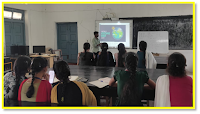
Performance of Students of Dept of Physics at state level Jignasa competition held on 03rd May 2023


Subscribe to:
Posts (Atom)
Gallery
1 / 5

Caption Text
2 / 5

Resource Person in Workshop at Women 's College, Nizamabad
3 / 5

Caption Three
4 / 5

Caption Four
5 / 5

Caption Four